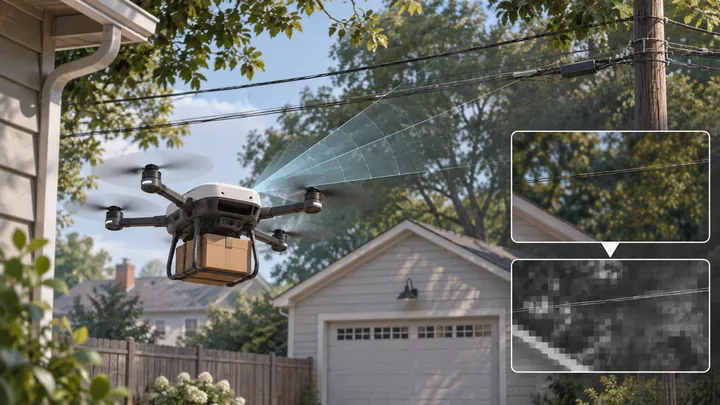
An Amazon Prime Air delivery drone struck a fiber-optic cable after dropping off a package in Huntington Woods, Michigan, then became entangled with power lines and came down on a neighbor’s garage. The Federal Aviation Administration is investigating the Nov. 20 incident, according to Ars Technica, which reported that the FAA’s preliminary notice described the aircraft striking a fiber cable and residential garage before becoming caught in power lines.
No one was reported injured. The garage sustained damage, according to homeowner Logan Coomes, as reported by the Detroit Free Press. Utility DTE said its crew de-energized a line to help remove the aircraft. The National Transportation Safety Board was gathering information but had not decided by Nov. 22 whether to open its own investigation, the Free Press reported; that is a separate process from the FAA’s inquiry.
A narrow wire, a demanding sensing problem
The crash matters beyond the inconvenience of a damaged roof because it puts autonomous obstacle avoidance in the kind of setting that is easy to overlook in a flight diagram: thin cables against trees, roofs and changing light. A system can navigate a planned route and still face a difficult last few metres around a delivery site. Detecting an obstacle is only part of the job; the aircraft must also estimate its position and motion, choose a safe response and have enough room to carry it out.
Amazon says its MK30 drones use cameras and other sensors to navigate and avoid obstacles, and Ars reports that the aircraft has onboard sense-and-avoid technology. The company’s description establishes what it says the system is designed to do, not how it performed in this flight. The public accounts do not establish which sensor detected—or failed to detect—the cable, whether the cable was visible to the aircraft, what maneuver it attempted, or why the drone struck it. Those answers require evidence such as flight and sensor records, which has not been made public in the reporting reviewed here.
Witness Jim Brennan told WXYZ that the drone had delivered the package and was climbing when it caught the cable. The Free Press reported accounts from residents and DTE about the cable strike and the aircraft becoming caught near a power line. These are eyewitness and utility accounts, not a completed technical finding. The FAA investigation may establish a sequence and contributing factors; at this stage, it would be premature to call the incident a particular software or perception failure.
Autonomy meets the neighborhood
Prime Air says its routes are planned in advance, monitored by flight staff and conducted under FAA-approved beyond-visual-line-of-sight authorizations. Its public operations description also says the drone descends to about 13 feet for delivery and can change the delivery point if it detects ground hazards. Those safeguards address different parts of the operation; they do not by themselves demonstrate that every narrow overhead wire near a delivery point will be detected and avoided.
The episode also shows why deployment conditions matter. Wires between homes, detached garages and constrained yards create close-range hazards that may not be captured by broad route planning alone. A system’s safety case must account not just for whether it can complete deliveries, but for where it is allowed to descend, how it responds to hazards on the climb out, and how incidents feed back into site eligibility and operating procedures.
Amazon told news outlets that Prime Air had made hundreds of thousands of deliveries in 2026 and that incidents were rare. That is the company’s account; the number alone does not supply a denominator for this particular risk, a breakdown by operating conditions or an independent measure of safety. Ars reported that the FAA’s notice was posted Nov. 23, three days after the crash. The agency’s public preliminary-notice page describes such entries as preliminary and subject to change. No final finding on this incident was available in the sources reviewed for this article.
For now, the verified lesson is modest but important: autonomous delivery is not simply a route-planning problem. It has to work amid the physical clutter of the places where packages are actually dropped. Whether the MK30’s sensing, operating procedures or delivery-site rules fell short here remains for investigators to establish.
Sources: Ars Technica’s report on the FAA investigation; Detroit Free Press reporting on the crash and NTSB status; WXYZ interviews with witnesses; Amazon Prime Air’s description of its operations; FAA preliminary-notice page.