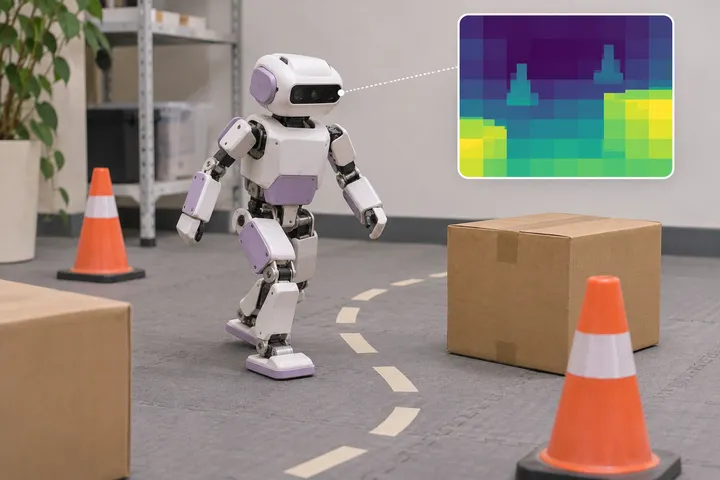
A small biped can already walk and stay upright, yet still need help with the next obvious problem: not walking into a box. A NVIDIA-authored tutorial published on Hugging Face on Nov. 24 shows how its Microduck robot can get a separate obstacle-avoidance controller, trained in simulation while leaving its walking policy unchanged.
The distinction matters. This is not one all-purpose robot brain learning locomotion and navigation at once. The tutorial’s navigation policy reads time-of-flight (ToF) distance measurements and adjusts a person’s gamepad velocity commands; a previously trained, fixed walking policy then turns those commands into joint movements. Think of it as a cautious co-driver layered over the legs.
Training many courses at once
The workflow uses NVIDIA’s Isaac Lab for robot-learning environments and Newton for physics and simulated sensor depth. Obstacle layouts vary between episodes, using boxes, bins, cabinets, cones and barriers. The modeled VL53L5CX ToF sensor supplies an 8-by-8 grid of distance readings at 15 Hz, with a reported 45-degree field of view and 0.12-to-4-meter range. The training setup adds noise, delays and missing readings to make the simulated input less pristine.
NVIDIA’s tutorial specifies 16,384 parallel simulated environments and 1,500 Proximal Policy Optimization (PPO) iterations for its example training run. It also reports a smaller run on NVIDIA DGX Spark: 4,096 environments, 3,000 PPO updates and about six hours. Those are configurations and a company-reported elapsed time, not a comparable performance benchmark. The post does not give a common hardware baseline, energy use, success rate across a stated test set, collision rate or uncertainty range that would let readers rank the run against another training system.
Simulation is a rehearsal, not a field record
The public workflow goes beyond a simulator: it documents exporting the navigation policy to ONNX and running it from a laptop alongside the walking policy on a configured physical Microduck. The tutorial calls for a dry run that streams sensor data without sending movement commands, then supervised gamepad testing. It describes a default forward-speed cap of 0.15 meters per second, a close-obstacle brake and a stop when input becomes stale.
That is useful deployment guidance, but it is not evidence of reliability in varied real-world settings. The tutorial does not publish a systematic real-world trial count, obstacle-avoidance success rate or comparison with an alternative controller. Its recorded demonstration and setup instructions establish a concrete sim-to-real path; they do not establish how often the robot succeeds outside the shown course. Even the authors advise testing scenes outside training before taking the policy to the robot.
For AI robotics, the useful result is the modular approach: train steering without discarding a working balance controller, and make simulated sensor imperfections part of the exercise. The open Isaac Lab task code gives developers something inspectable to reproduce. The harder question—whether it remains safe and dependable across unfamiliar floors, lighting, sensor glitches and clutter—needs measurements beyond a tutorial. A successful rehearsal is progress; it is not yet a road test.
Source: NVIDIA-authored Microduck obstacle-avoidance tutorial, published Nov. 24, 2026. Dispatch reviewed the tutorial and its linked task code; the performance and deployment claims above are attributed to that source, not independently reproduced.