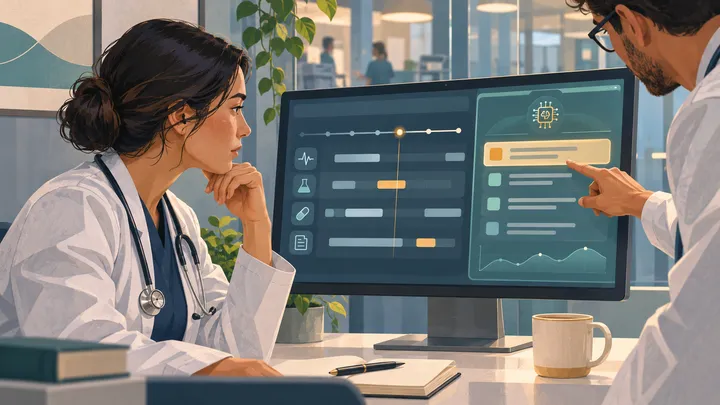
In 2023, Boston Children’s Hospital hired Dinesh Rai for a job title that sounded like a snapshot of the generative-AI boom: prompt engineer. Three years later, the work has moved well beyond finding the right words to put in a chatbot. The harder questions are how a model fits into clinical systems, what evidence its output rests on, and who catches it when it is wrong.
That shift is the through-line of Rai’s account to IEEE Spectrum. Rai, an emergency physician with clinical-informatics training, now splits his time between engineering and conversations with clinicians, the magazine reports. The role is less about coaxing a model into a polished answer than designing a system around messy medical records and real decisions.
Finding a useful match in a crowded chart
One project, called Clinical Doppelgangers, aims to help clinicians find earlier patients whose cases resemble a complicated case in front of them. The idea is to surface relevant trajectories and interventions from a hospital’s historical data when published guidelines, built around larger populations, may not map neatly onto an individual child.
In a January 2026 technical account, Boston Children’s and Amazon Web Services described a system that combines structured measurements with language-derived representations of clinical notes. An LLM-based agent translates a clinician’s natural-language question into a search plan across that repository, then returns a candidate cohort. The authors said the pipeline had processed more than 6,000 pediatric cardiac intensive-care cases and contained more than 250 structured measurements. Those are implementation figures reported by the project’s developers, not an independent evaluation of clinical benefit.
That distinction matters. Finding similar cases can help clinicians explore what happened before; it does not show that a treatment caused a better outcome, and it cannot replace randomized trials. AWS’s account says clinicians use the results to inform decisions and describes expansion goals, but it does not publish a controlled comparison showing improved patient outcomes. The system is best understood as a search and decision-support tool under development, not an automated source of treatment advice.
More context is not always better
Rai also described a separate design debate: how much of a patient record to provide when asking a model to identify findings relevant to an outcome. Developers initially reasoned that more information could help; clinicians expected the model to ignore irrelevant details. Rai warned that both assumptions can fail. An abnormal laboratory result may be real but beside the question, while a language model can still produce a convincing-sounding explanation connecting the two.
This is a familiar limitation of generative systems: fluent explanations are not proof that the evidence supports the conclusion. In medicine, indiscriminate context can create more opportunities for irrelevant details to shape a plausible answer. Selecting information, preserving its source, and making the output checkable are engineering decisions as much as clinical ones.
Human review is part of the system
For a clinical-note drafting tool, Rai told IEEE Spectrum, clinicians who would use the system reviewed generated notes before they were finalized. That workflow recognizes an important asymmetry: a clinician who knows a complex patient may catch an error that a quick chart skim misses. The article describes a review process, not a measured error rate or trial demonstrating safety.
That is why prompt craft has not simply vanished; it has been overtaken by less glamorous work. A dependable clinical AI system must connect to the right data, preserve the distinction between signal and coincidence, make its sources visible, and fit into a workflow where a qualified person can challenge its output. The prompt is one part of that chain, and not necessarily the part most likely to keep a bad answer from reaching a chart.
Rai’s career offers a useful case study, not a universal forecast for hospital jobs. The public evidence here is a reported interview and a developer-authored technical description of one system. Neither establishes that clinical AI tools are broadly safe, effective, or ready to practice medicine on their own. What they do show is where the practical work is accumulating: at the boundary between models, records and human judgment.
Sources
- IEEE Spectrum, “This ER Doctor Became a Hospital’s First Clinical AI Engineer,” published November 27, 2026. Interview-based reporting; claims about Rai’s role and clinical workflows are attributed to the article and its interviewees.
- Boston Children’s Hospital and Amazon Web Services, “Clinical doppelgangers: Accelerating pediatric insights,” January 6, 2026. Developer-authored system description; implementation metrics and goals are not independent evidence of clinical benefit.