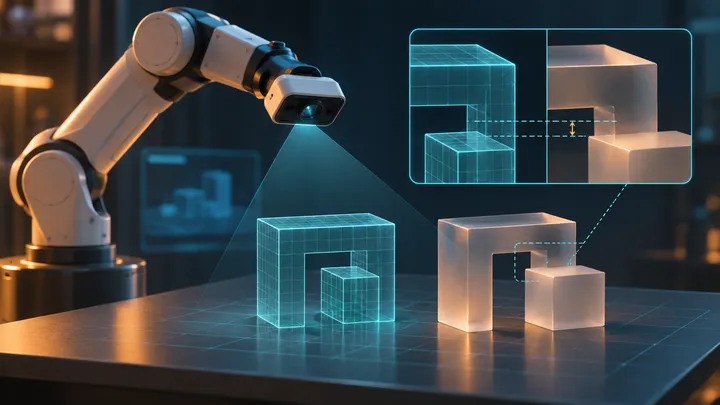
When Simon Willison asked frontier language models to make 3D scenes, the results looked like a new capability. The more consequential question for robotics is harder: does writing code that draws a plausible three-dimensional world mean a model understands the one a robot must move through?
Willison, a software developer and AI commentator, framed his November 24, 2026, blog post as a year of three personal “inflection points” in large language models and coding agents. He described coding assistants becoming useful in daily work, models taking on longer tool-using tasks, and newer systems producing more convincing 3D models and games. The last trend, he suggested, might matter for robotics because spatial awareness is important to vision-enabled robots. But he explicitly said he did not know whether advances in 3D modeling and robotics research were connected. His examples are firsthand observations, not a controlled comparison of models or a test of robot performance.
A rendered scene is not a robot-ready map
There is a meaningful gap between generating a 3D scene and understanding physical space. A model asked to create a scene in Blender or write Three.js code can produce a program that renders objects from specified geometry and viewpoints. A robot, by contrast, must infer where objects are from sensor data, cope with occlusion and changing viewpoints, and make decisions that work with imperfect measurements and physical constraints. A polished render can be evidence of useful coding and visual-generation skill; on its own, it does not show that the system can reliably localize a cup, estimate its depth or guide a gripper to it.
Research offers a useful caution against treating one output as a general capability test. In a 2026 preprint introducing SpatialBabel, researchers reported that vision-language models could generate code reconstructing simple 3D scenes with reasonable geometric structure while failing easier spatial questions about the same scenes. Their evaluation covered 14 models and found that reconstruction scores varied substantially depending on the scene-description language used. The study is not an assessment of the particular models or examples in Willison’s post, and its results do not establish how a robot would perform. They do show why the ability to emit a compelling 3D artifact and the ability to answer spatial questions should be measured separately.
That distinction matters because a robot’s mistake is not confined to an odd-looking picture. A misplaced object in a visualization can be a cosmetic blemish; a misplaced estimate in a manipulation pipeline can send a robot toward the wrong target. Real systems must connect perception to action, account for sensor and calibration error, and demonstrate performance under the actual conditions in which they will operate. Neither a generated animation nor a software agent’s successful completion of a desktop task establishes that chain.
Promising signal, incomplete evidence
Willison’s examples still point to a potentially useful direction. Models that can write or revise 3D scene code may help people prototype simulations, build interfaces for inspecting spatial data, or translate a verbal idea into a visual test. Those are plausible development tools—not proof that a general-purpose model has acquired a robot’s practical sense of depth, reach or collision risk. The distinction between designing a map and navigating by one is not pedantry when the next step involves a moving machine.
The Anthropic launch material for Claude Opus 5.5, one of the models Willison discussed, highlighted coding, agentic work and a company-run test in which a model built a game from a prompt. It did not report a robotics or physical-spatial benchmark. The company’s results are vendor evidence about its own evaluations; Willison’s post supplies a practitioner’s account of use; neither independently verifies the other’s claims about robotics-relevant spatial understanding.
So the reported 3D leap is worth watching, but its robotics significance remains open. To establish more, researchers would need evaluations that separate scene generation from spatial reasoning, then test whether measured gains transfer to perception and action in simulation and on real robots. Until then, a model that can make a convincing virtual world may be a better 3D collaborator. Whether it can reliably find its way around the real one is a different experiment.
Sources: Simon Willison, “Three LLM inflection points in twelve months,” November 24, 2026; “3D Primitives are a Spatial Language for VLMs,” arXiv:2605.12586, 2026 preprint; Anthropic, Claude Opus 5.5 announcement, September 22, 2026.