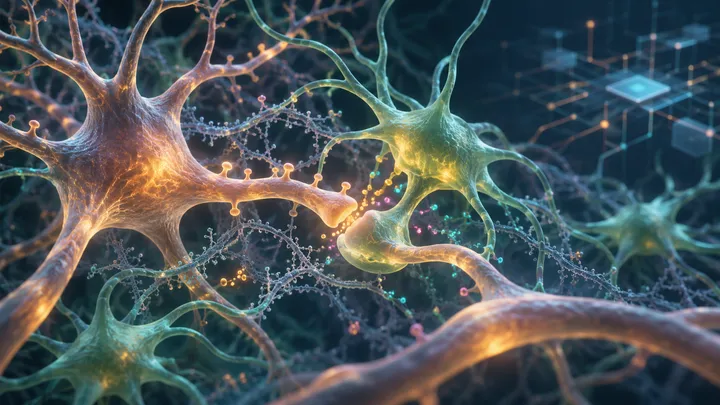
A review published in August proposes that memory may depend not only on electrical activity between neurons but also on astrocytes and the molecular environment around brain cells. Its authors use that proposal to question whether more computing power could ever produce human-like consciousness. The first claim is a hypothesis about biology; the second is a philosophical implication, not a result demonstrated by an experiment.
That distinction matters in a field where fluent behavior can tempt observers to treat a difficult question as settled in either direction. A biological account of memory might sharpen what researchers ask about machine consciousness. It does not, by itself, establish that a machine could—or could not—have subjective experience.
A proposed tripartite mechanism
Gerard Marx, of MX Biotech Ltd., and Chaim Gilon, of the Hebrew University of Jerusalem, describe their framework in “Consciousness, Memory and Intelligence: A Mechanistic Perspective,” published in the International Journal of Psychiatry Research. The paper appeared online on Aug. 4, 2026, according to its DOI record. It is a review and theoretical proposal, not a report of a new controlled experiment.
The authors call their model the Tripartite Mechanism of Memory. It proposes that memory involves three interacting elements: brain cells, especially astrocytes working with neurons; the extracellular matrix and perineuronal nets around cells; and chemical “dopants,” including metal ions, neurotransmitters and gliotransmitters. In their account, those interactions could provide a physical substrate for storing cognitive information and its emotional context.
Astrocytes are support cells that also communicate with neurons and influence their local environment. Research in neuroscience has established that they do more than passively fill space, but the specific role assigned to them in this proposed memory code is not established by the review. Nor does the paper demonstrate that memories are written and read in the precise chemical manner its model suggests.
Where the argument reaches beyond the evidence
The authors extend their proposal from memory toward thought, intelligence and consciousness. They argue that biological memory is embodied in living tissue and linked to emotional and bodily responses, unlike digital information stored in electronic hardware. From this contrast, they challenge the idea that scaling computational complexity alone would necessarily yield consciousness like that of a living organism.
That is a legitimate question to pose, but the article does not test an AI system, define a measurable threshold for consciousness or compare biological and artificial systems under a shared experimental framework. The paper itself says the mystery of conscious life remains unresolved. Its suggestion that the brain’s chemistry may be essential is a research hypothesis—not evidence that existing AI is conscious, or proof that artificial consciousness is impossible.
There is also a difference between explaining a candidate mechanism and showing that it explains memory. A compelling account would need testable predictions and empirical evidence distinguishing the model from alternatives: for example, evidence that the proposed matrix-and-chemical interactions encode specific memories, and that changing them predictably changes recall. This review sets out a framework; it does not report that demonstration.
What this means for AI
For AI research, the paper’s most useful contribution may be a reminder that intelligence-like performance and biological consciousness are not interchangeable concepts. Today's machine-learning systems process information in physical hardware, but that fact alone neither settles what consciousness requires nor tells us whether a non-biological system could meet those requirements.
The ScienceDaily story, published Nov. 25, framed the proposal as a challenge to the prospect of AI consciousness. The underlying paper was published months earlier, on Aug. 4; the later ScienceDaily date is the date of that coverage, not the date of a new discovery. The university-supplied release distributed through EurekAlert appeared Aug. 18 and describes the same paper, so it is not independent confirmation.
Until the proposed biological mechanism is tested and the terms “intelligence” and “consciousness” are made operational for comparison, the theory cannot draw a firm boundary around what machines might experience. Chemistry may be central to how human memory works. The broader claim about AI remains an open question—not a verdict.
Sources: Gerard Marx and Chaim Gilon, “Consciousness, Memory and Intelligence: A Mechanistic Perspective,” International Journal of Psychiatry Research (2026), doi:10.33425/2641-4317.1251; Hebrew University of Jerusalem release via EurekAlert!, Aug. 18, 2026; ScienceDaily coverage, Nov. 25, 2026.