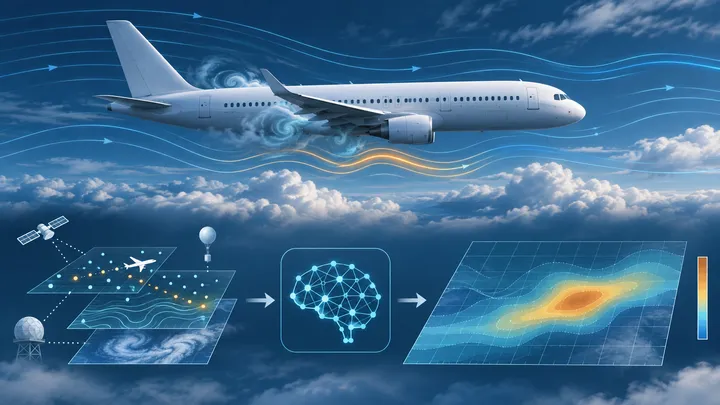
Turbulence forecasts are getting more useful for an unglamorous reason: aircraft are already measuring and broadcasting more than their passengers can see. The challenge is turning those scattered observations into warnings that are timely, reliable and honest about uncertainty.
That is where machine learning enters the picture—not as a solution to turbulence physics, but as a way to find patterns across large, messy datasets. The distinction matters. Better prediction can help crews avoid rough air; it does not mean researchers can calculate every twist in the atmosphere or promise a smooth flight.
Aircraft as moving weather stations
The Federal Aviation Administration says ADS-B Out broadcasts an aircraft’s GPS position, altitude and ground speed to ground stations and other aircraft once per second. Those signals are designed for air-traffic surveillance, not turbulence forecasts. But combined with reports of the aircraft’s response to the air and meteorological models, they can help researchers identify where conditions depart from expectations.
In a WIRED report published Nov. 25, 2026, researchers described efforts to use aircraft broadcasts and other crowdsourced observations to improve forecasts. The report says physicist Larry Cornman of the National Center for Atmospheric Research and an FAA air-traffic controller showed how such broadcasts could help spot unexpected turbulence without new equipment aboard planes. That is a promising data source, not a complete map: aircraft follow particular routes and altitudes, and a measurement arrives only where a plane happens to be.
A separate peer-reviewed study illustrates what machine learning can demonstrate under more defined conditions. In npj Climate and Atmospheric Science, Ye-Seul Lee and Hye-Yeong Chun evaluated random-forest, XGBoost and LightGBM models for global low-level turbulence forecasts, using about three million paired turbulence diagnostics and in-flight eddy-dissipation-rate observations. The authors reported that all three models consistently outperformed the low-level version of the Graphical Turbulence Guidance system they used for comparison. They also found performance varied by season, time of day and altitude.
Eddy dissipation rate, or EDR, is a measure used to characterize turbulence intensity. It gives researchers a way to compare forecasts with observations, but a model’s success against a particular dataset and benchmark is not the same as proof of safer operations across every airline, region or flight level.
Forecast skill is not certainty
The study’s authors treated that gap as part of the problem. Their methods included adjusting thresholds, addressing the rarity of turbulence examples in the training data, and estimating prediction intervals to represent spatially varying uncertainty. Those steps matter because a system trained on many ordinary conditions can still struggle with the comparatively rare severe events that are most consequential.
There are also basic limits to what observations can capture. Turbulence forms at many interacting scales, while aircraft sample only a thin, moving slice of the atmosphere. Weather forecasts add context, but they cannot supply a perfect real-time picture of every eddy. Machine learning can extract useful statistical regularities from that partial view; it cannot turn missing measurements into direct observation.
Commercial products make a further claim about practical lead time. SkyPath CEO Maya Shpak told WIRED that the company’s app, which combines data from accelerometers in pilots’ tablets with weather information, can warn crews 10 to 15 minutes ahead. That is a company-reported capability, not an independently published accuracy assessment in the material reviewed here. WIRED also quoted Cornman warning that forecasts reaching 80 percent accuracy are not imminent. The article does not provide a common operational test that would let readers compare the vendor’s warning claim with the research benchmark.
The near-term payoff is therefore more modest—and more credible—than solving turbulence. Better forecasts could give pilots additional opportunities to adjust routes, manage cabin preparation and alert passengers. Whether a warning is useful depends not just on a headline accuracy number, but on false alarms, missed events, geographic coverage and how much actionable lead time remains.
More data, better questions
There is a wider scientific opportunity, too. The National Science Foundation announced a $30 million award for Tempest, a research center involving nine universities and led by Michigan State University’s Michael Murillo, according to WIRED. The center will study turbulence in settings beyond aviation, including fusion plasmas and cosmic gas clouds. That is a research program, not evidence that an AI system has solved those problems.
For aviation, the useful test is whether independent evaluations show that data-driven forecasts improve on existing guidance across different routes, seasons, aircraft and kinds of turbulence—and whether they communicate uncertainty in a form crews can act on. A fuller sky of observations may bring that goal closer. It still won’t make the atmosphere file a flight plan.
Sources: FAA, Automatic Dependent Surveillance–Broadcast (page updated Sept. 29, 2025); Lee and Chun, “Machine learning application and operational strategy for global low-level aviation turbulence forecasting,” npj Climate and Atmospheric Science, published Nov. 25, 2025; WIRED, “Airplane Turbulence Is Extremely Hard to Predict, but Maybe Not for Long,” published Nov. 25, 2026. Research checked Nov. 25, 2026.