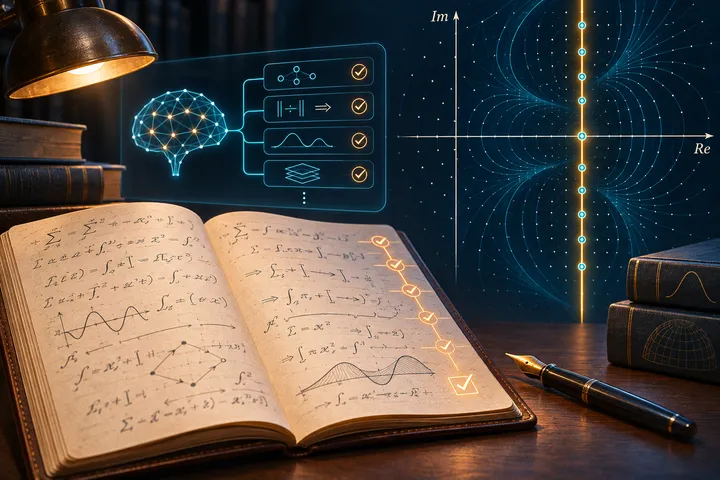
A claim that the Riemann hypothesis had been proved by an AI-assisted effort began circulating last week. By the time Ars Technica revisited it on Nov. 24, the story had moved beyond an announcement: the Lean and Mathlib communities had publicly certified the formal proof, while a human-readable explanation of its central mathematics remained unfinished.
That distinction matters. The hypothesis, proposed by Bernhard Riemann in 1859, says that the nontrivial zeros of the zeta function all lie on a particular vertical line in the complex plane. It is a major open problem because those zeros encode deep information about the distribution of prime numbers. A proof would be an extraordinary mathematical result; checking that a computer formalization proves the right statement is a different, narrower task from making its ideas intelligible to mathematicians.
What was checked
Levent Alpöge, a mathematician at Anthropic, released a Lean library on Nov. 20 and said he developed the argument with Claude. In his personal note, Alpöge describes giving Claude a direction drawn from a simplified “toy” setting, then guiding it toward the full problem. He says the model supplied much of the route near the end. That account is the author's description of the collaboration, not an independently measured breakdown of human and model contributions.
Lean is a proof assistant: a program checks whether each step follows from definitions and previously established results under a formal logical system. A successful check is not a language model grading its own homework. But it does depend on identifying the theorem correctly and ensuring the checked code really establishes it, rather than a nearby or weakened claim.
On Nov. 21, a joint statement from the Lean and Mathlib communities, endorsed by the Lean FRO and Mathlib Initiative, said the library compiled, the theorem matched Mathlib's statement of the Riemann hypothesis, and the exported proof was checked by Lean's kernel and other checkers. The statement concluded that they had full confidence in the proof's correctness. That is substantial independent technical scrutiny of the formal artifact—not merely Alpöge's assertion that his code ran.
Mathematician Michael Rubinstein at the University of Waterloo separately documented checks of the archive, including a full compilation and replay through Lean's kernel, and reported agreement from an independently written checker. His page also links a working explanatory manuscript that derives the result from a key inequality whose proof is taken from the Lean development. This is meaningful progress toward understanding, but it is explicitly a work in progress, not yet a complete human-readable account of every central step.
Proof is not the same as explanation
Alpöge's own note says the formalization was complete while the argument was too long and unreadable to publish as ordinary mathematics; he says he intends to understand and explain it. His announcement also claims extensions to generalized and extended versions of the hypothesis. The community statement verifies the stated Riemann-hypothesis theorem; the extensions should not be treated as equally established without checking their exact formal statements and independent verification.
Ars noted the announcement's florid language and hints of joking. Alpöge later clarified in his note that a boast about producing more than 250,000 pages was a joke. The formal proof and the jokes around its announcement are separate matters: the former has received rigorous machine-checking and community endorsement; the latter are not evidence for or against the theorem.
The AI significance is real but bounded. A model reportedly helped generate mathematical reasoning in a process whose output could be translated into a form independent checkers can validate. That is more than an AI system producing plausible-looking prose. Yet the verification establishes the proof object, not a general ability to solve arbitrary mathematics, nor a clean division of intellectual labor. The next test is whether mathematicians can extract, simplify and communicate the argument—and whether this workflow can be repeated on other problems.
Sources: Ars Technica, Nov. 24, 2026; Levent Alpöge's note, Nov. 20; Lean and Mathlib communities' statement, Nov. 21; Michael Rubinstein's verification notes.