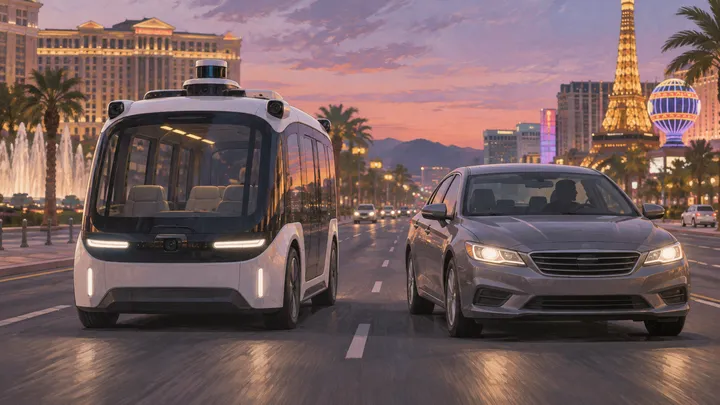
Las Vegas may soon offer riders something the autonomous-vehicle industry has long lacked: a visible choice between a human-driven ride and a driverless one inside the same app. That could reveal how customers respond to robotaxis in everyday service. It will not, by itself, tell us whether the machines are safer, more reliable or cheaper to operate.
The distinction matters because the first version of this comparison is not a controlled experiment. Uber users in Las Vegas can be matched with a Zoox robotaxi when one is available, but cannot yet directly select it; they can adjust preferences to increase their chances, according to TechCrunch’s Nov. 16 report. In its Nov. 4 third-quarter prepared remarks, Uber said it planned to introduce a dedicated autonomous option as availability and reliability improve, with limited fleets initially and expansion over time. That is a company plan, not a guarantee of a launch date or service level.
A choice shaped by supply
The basic question is appealing: when a rider can choose, will they take a robotaxi or a human-driven car? But choice depends on more than preference. If autonomous vehicles are scarce, serve fewer routes, arrive later or carry a different price, the app is testing a bundle of service conditions as much as it is testing attitudes toward automation.
Uber says Las Vegas is expected to become the first U.S. city where riders can access two fully driverless partners through its app: Amazon-owned Zoox and Hyundai subsidiary Motional. The company’s prepared remarks say it intends to start with limited fleets. A driverless ride is not a driverless industry: the vehicle still depends on a functioning operational service, and the evidence cited here does not establish how either partner’s performance compares with human drivers across matched routes and conditions.
Nor would a rider’s selection measure technical capability. A customer might choose a robotaxi for novelty, privacy or price—or avoid it because a wait is longer or the vehicle feels unfamiliar. Trip requests, completed rides, cancellations and repeat use could help describe demand, but interpreting them would require details such as fares, wait times, service areas, vehicle availability and how the app presents each option. Those conditions can change while fleets scale.
What would make the comparison useful?
A stronger public comparison would separate customer preference from operational performance. For the former, riders need a meaningful, clearly presented choice with comparable fares and availability. For the latter, useful measures would include completed trips, cancellations, pickup times, service interruptions and driverless miles, reported with their time period and operating area. Safety claims need their own careful denominators and context; a raw vehicle count or a tally of rides cannot establish relative risk.
TechCrunch’s Nov. 22 newsletter notes that vehicle registrations are a poor proxy for market leadership and points instead to commercial driverless miles and miles per vehicle as potentially more informative measures. Those metrics still need consistent definitions and disclosure. A mile accumulated in a tightly bounded service area is not automatically comparable with a mile driven in a broader or more difficult operating environment.
The underlying technology is autonomous driving: onboard systems must perceive surroundings, predict how other road users may behave and plan vehicle motion without a human at the wheel. Zoox describes its service as built with AI, computer vision and engineering, but that is the company’s own high-level account, not an independent evaluation of its system. The public evidence reviewed here supports a story about deploying AI-enabled autonomous vehicles into a ride-hailing service; it does not establish a technical head-to-head performance result.
So Las Vegas may become an unusually visible marketplace test—one shaped by software, fleet supply, pricing and human expectations. Calling it an A/B test of robots versus people is a useful metaphor, but a generous one. The app can show who accepts the ride. To explain why, and what the vehicles can reliably do, observers will need better data than a tap on a screen.
Sources: Kirsten Korosec, TechCrunch Mobility, Nov. 22, 2026; Uber Q3 2026 prepared remarks, Nov. 4, 2026; TechCrunch, Nov. 16, 2026; Zoox company description. Reporting research conducted Nov. 22, 2026.