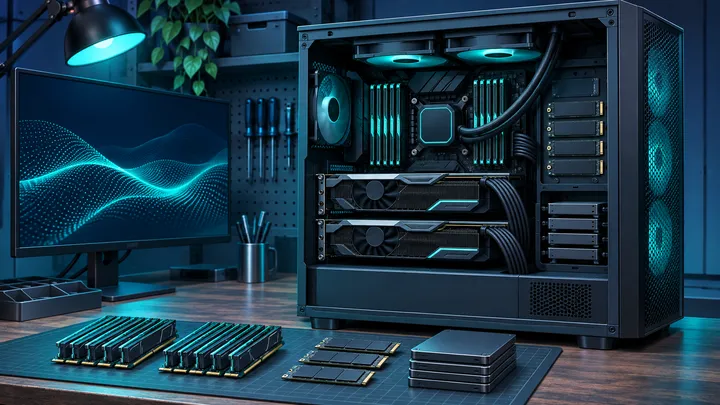
A homelab builder has reported running Moonshot AI’s 2.8-trillion-parameter Kimi K3 model at 3.11 tokens per second on a system combining second-generation Intel Optane persistent memory, a RAM-backed disk and two GeForce RTX 3090 graphics cards. The result is an instructive demonstration of how a huge model can be split across memory and compute—not a standardized measure of how fast the hardware, or Kimi K3, will run elsewhere.
In a Reddit follow-up posted on November 20, the builder says both tests used Kimi K3 Q2_K, llama.cpp and two RTX 3090s, with direct access (DAX) enabled for the Optane portion. With all 94 model shards—865 GB in total—stored on Optane, generation reached 2.20 tokens per second and prompt evaluation reached 13.3 tokens per second. Moving 45 shards, or 414 GB, to a temporary RAM-backed filesystem (tmpfs) raised those figures to 3.11 and 16.8 tokens per second, respectively.
Those are the builder’s measurements for two memory-placement configurations on one machine. They amount to about 41% higher generation throughput and 26% higher prompt-evaluation throughput in the RAM-drive configuration, but they do not isolate every system variable or establish a general Optane-versus-DRAM result. Prompt evaluation processes input context; generation measures output-token production. They are different stages, so the two rates should not be treated as interchangeable.
The GPUs accelerate parts, not the whole model
The system’s two RTX 3090s have 48 GB of video memory combined—far short of the 865 GB model file. The builder says the large routed-expert tensors stay on the CPU and memory side, while the GPUs handle attention, dense feed-forward components, shared experts, the key-value cache and compute buffers. Kimi K3 is a mixture-of-experts model: Moonshot’s documentation describes 896 routed experts, with 16 selected per token, alongside shared experts. That architecture lets the system use GPU compute for selected components without holding every model weight in GPU memory.
In other words, this is not a 2.8-trillion-parameter model resident on two gaming cards. It is a hybrid arrangement that relies on very large host memory and storage capacity, with GPUs accelerating selected work. The distinction matters: parameter count describes the model’s total learned weights, not the amount of work or memory required in exactly the same way for every token in a sparse model.
The experiment builds on the same user’s earlier CPU-only Optane setup, but the follow-up explicitly warns against treating those earlier results as a controlled CPU-versus-GPU comparison: the quantization and configuration differed. It also is not a DAX-on versus DAX-off test. The hardware builder described modifying the chassis and relocating the power supply to fit the cards, and says active cooling remains necessary for the Optane modules.
A demonstration, not a throughput promise
The post gives a useful look at the capacity trade-off behind local inference at a scale far beyond ordinary graphics-card memory. It also shows how shifting hundreds of gigabytes between persistent memory and DRAM can affect the reported throughput in this particular workload. It does not show that a typical desktop can reproduce the result: the builder’s machine, memory capacity, software settings and model quantization are unusual, and the available measurements are self-reported rather than independently reproduced.
Moonshot’s Kimi K3 documentation identifies the model as a 2.8-trillion-parameter mixture-of-experts system. The benchmark figures and component placement here come from the homelab builder’s Reddit post, as reported by Tom’s Hardware; we have not independently run the configuration or verified the measurements.
Sources: the builder’s November 20 Reddit post; Tom’s Hardware, November 21, 2026; Moonshot AI’s Kimi K3 documentation.