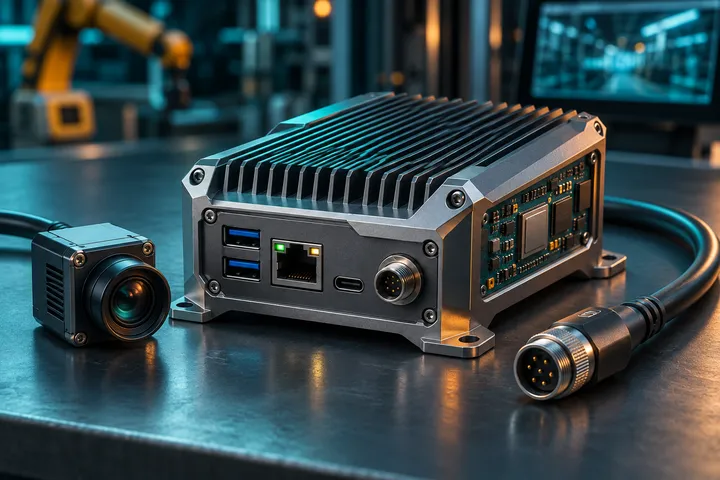
A brain-computer interface can turn attempted speech into words, but the electronics doing the translation still occupy a cart. Paradromics says a new partnership with Nvidia is intended to move that computation closer to the user: first into a wheelchair-mounted box, and eventually, the company hopes, into a phone-sized device.
The near-term plan is a hardware-and-software stack, not a newly announced implant. In WIRED’s Nov. 23, 2026 report, Paradromics said it plans to use Nvidia’s Jetson computing module for local speech decoding and Holoscan software to process neural signals alongside other sensor streams. The company’s chief scientific officer also told WIRED that Nvidia foundation models could be integrated to make synthesized voices more expressive.
That distinction matters. The implant records neural activity; the external computer runs the interpretation and communication pipeline. More than 400 embedded electrodes capture signals as a participant attempts to speak, and AI models infer intended words. The output can then appear on a screen or be spoken aloud. This is not a brain implant running a general-purpose chatbot, and the partnership announcement does not establish that the system has become smaller, lower-power or faster in practice.
Moving computation closer
Paradromics describes the current equipment as a cart that must be plugged into an outlet, with the user within range. The company’s stated goal is to replace it with a small box that can sit on a wheelchair in about a year; a phone-sized system is a longer-range aspiration attributed to founder and CEO Matt Angle. Those are plans, not independently demonstrated delivery milestones.
Jetson is Nvidia’s embedded computing platform. Holoscan is software for building sensor-processing pipelines. In this application, the pitch is that neural signals—and potentially inputs from cameras or microphones—can be processed locally, close to where they are generated. That is the “edge” in edge computing: compute at or near the device, rather than relying on a distant data center.
Local processing could reduce dependence on internet connectivity and avoid sending raw neural streams to a remote service. But the public announcement, as reported by WIRED, gives no power budget, device dimensions, benchmark, latency measurement, model details or comparison with the existing cart. “Low lag” is a design goal; without a disclosed test protocol and measured end-to-end delay, it is not a performance result. Nor does the partnership establish how much of the existing computing workload Jetson will handle.
The technical challenge is not simply shrinking a box. A practical wearable system must sustain enough compute for decoding and any additional models while meeting power, thermal, reliability and safety constraints. Continuous neural signals are also noisy and can change over time. Nvidia’s health-care business-development director told WIRED that such signals require AI that can adapt to the individual; that is a company representative’s description of the problem, not published validation of a particular adaptive model.
Promising use, early evidence
The human stakes are unusually concrete: WIRED describes a Michigan participant identified only as Mary, who has motor neuron disease and uses the implant to express thoughts through synthesized speech. The report says this arrangement currently ties her to cart-based equipment. Greater portability could expand where and how she communicates, if the smaller system works reliably and is cleared for the relevant use.
Paradromics’ own website describes Connexus as being used in FDA-authorized clinical studies and says its study is decoding neural signals into real-time speech. That is company information, not evidence that the system is approved as a commercial product or that results generalize across patients. The public reporting on this Nvidia partnership does not provide participant counts, independent performance data, battery life, failure rates or a clinical comparison. Those omissions leave the portability and usability claims open questions, not reasons to dismiss the potential.
The same limits apply to privacy assurances. Nvidia’s representative told WIRED that Nvidia will not have access to brain data through these partnerships, and on-device processing can reduce the need to transmit data elsewhere. Neither statement, by itself, describes the complete data path, access controls, retention practices or security arrangements across all devices and services. Those details matter for neural data, which can be deeply personal.
For now, the significance is less “AI in the brain” than AI computation being brought nearer to a person who may depend on it to communicate. The partnership offers a plausible route from a powered cart toward a more mobile interface. Whether that route ends in a usable wheelchair-mounted device depends on engineering and clinical evidence that the announcement has yet to supply.
Sources: Emily Mullin, WIRED, Nov. 23, 2026; Paradromics company information. Research conducted Nov. 23, 2026. Partnership details and timelines are attributed to the company and WIRED’s reporting.